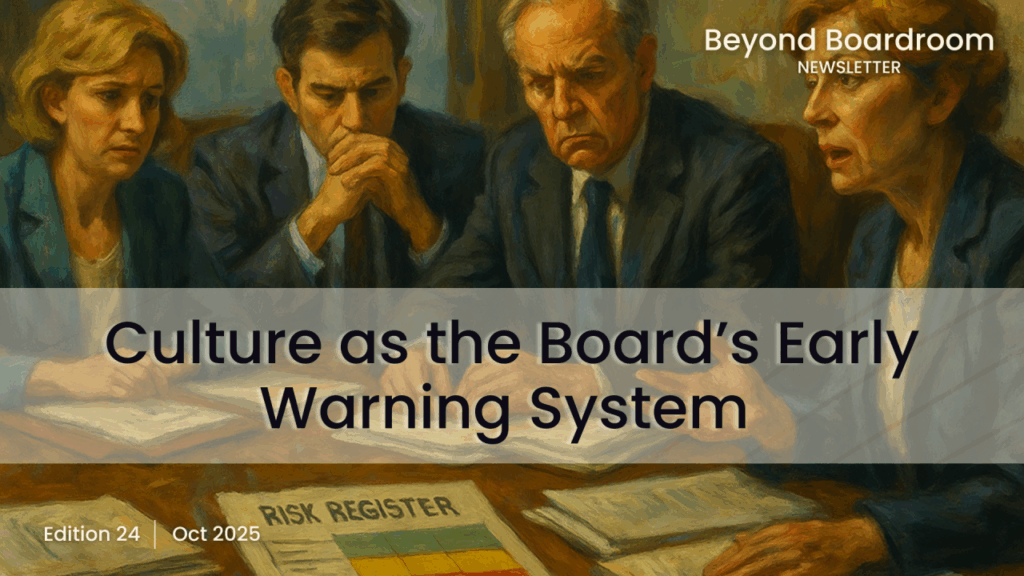
The boardroom is quiet. Papers are stacked neatly. The risk register, a tool used to catalogue and monitor organisational risks, shows its reassuring grids of amber and green. Yet around the table, unease hangs in the air. Something feels off. Staff are leaving faster than they should. A customer issue has been raised more than once. A director wonders aloud why these signals never appear in the pack.
This is the blind spot every board faces. Risk registers tell you what is documented. Culture tells you what is lived. And culture whispers long before risk shouts.
If boards want foresight, they must learn to treat culture as their early warning system.
Why culture signals earlier than the register
Culture is strategy in motion. It is the behaviour people choose when no one is watching and time is short.
The evidence is strong. Workplaces built on trust are consistently more productive and healthier (Harvard Business Review). Cultures that balance care with accountability are more innovative and resilient than those that lean too far toward comfort or control (MIT Sloan Management Review). Regulators have reinforced this, urging firms to see culture not as a slogan but as a driver of outcomes (FCA Discussion Paper 18/2).
Guidance on board effectiveness makes the point clear. Directors hold responsibility for culture, not just compliance frameworks (FRC Corporate Culture Guidance). Academic studies support the link. Companies with strong ethical norms create more long-term value (The Value of Corporate Culture, Journal of Financial Economics). Behavioural science shows how norms shape honesty in financial decisions (Cohn, Fehr & Maréchal, Nature).
What risk registers miss
Risk registers are vital. They track known exposures, assign ownership, and monitor mitigation. But they are not built for the subtle.
Consider a company where quarterly board packs arrived immaculate. The registers were complete. The numbers reconciled. Everything appeared in order. Yet when a serious operational failure erupted, directors asked the inevitable question: why did no one raise this? The truth was that they did. The warning was not written in the register but in exit interviews, in the silence at town halls, and in the repeated workarounds that staff quietly created to survive clumsy processes.
The register saw stability. The culture was shouting drift.
From soft talk to hard signal
Culture only becomes a useful radar when it is made observable. Boards need indicators that carry the same weight as financial metrics.
- When audit actions remain open too long, it signals complacency.
- When speak-up channels, such as whistleblowing hotlines or ethics reporting systems, fall silent, it suggests fear has taken hold rather than problems vanishing.
- When regretted attrition, meaning the departure of valued employees, rises in critical roles, it warns of erosion in capability.
- When customer complaints repeat with the same themes, it shows cultural neglect.
- When committees return the same paper multiple times, it reveals drift in management’s clarity and confidence.
None of these signals is soft. They are measurable, comparable, and predictive.
Building a culture radar the board can trust
A radar is only as useful as the clarity of its signals. To build one that boards can rely on, three ingredients are essential.
First, clarity of non-negotiables. People must know what always matters. If everything is urgent, nothing is. Resilient organisations define purpose and decision rights that remain clear even under pressure (World Economic Forum).
Second, layered listening. Surveys alone cannot capture culture. Boards need multiple channels: skip-level interviews, open forums, independent facilitation, and the Company Secretary weaving signals across committees. Internal audit can offer perspective on behaviour as well as controls (IIA Global, Auditing Culture, 2nd Edition).
Third, disciplined escalation. Cultural breaches must be treated as hazards, not HR trivia. They require quick routes upwards and visible responses downwards. Staff must see that speaking up makes the organisation stronger.
The Company Secretary’s role
The Company Secretary is often seen as a recorder of minutes. In truth, they are the board’s editor of focus. They sit at the intersection of risk, audit, people, and remuneration. They have the vantage point to see whether the story is coherent or fractured.
Their role is not only to collate but also to discern. To ask: what deserves attention? What belongs in supporting material? Where does the narrative conflict? And above all, what does the board need in order to decide with confidence?
One excerpt from my book The Secret Diary of a Company Secretary captures this well:
“Often, when a new company secretary is brought in, there’s a realisation that the previous service level was inadequate. If you’re good, CEOs frequently express surprise at the breadth of the role, saying they didn’t realise the full extent of responsibilities beyond just minuting meetings. Replacing a great company secretary is however challenging, much like replacing a CEO. The role is infused with personal traits, creativity, and values, making straightforward replacements impossible. A good company secretary learns to think like a CEO, a Non-Executive Director, and the chair all at once. Anticipating questions, staying several steps ahead, and creating value in every engagement is the real hallmark of the role.”
When the role is played well, the rhythm of the boardroom changes. Time shifts from translation to judgement. Directors move from asking “what does this mean” to debating “what should we do.”
Recommended by LinkedIn
Overcoming the Fear of Being Wrong in High-Stakes Roles
Mastering Compliance: How Strategic Leadership Fuels…
Beyond the Lines™: Newsletter – Issue 6
Practical governance moves
Boards that want to treat culture as foresight can begin with a few practical steps.
- A one-page cultural health summary by division forces candour. Green for alignment, amber for drift, red for conflict, with evidence attached.
- A decision log turns hindsight into insight. Did outcomes match intent? If not, what does that reveal about culture?
- Scenario rehearsals expose behaviour under stress. Observe who speaks up, who hesitates, and whose assumptions dominate.
- External reviews, used sparingly, can highlight cultural risks that insiders may have normalised.
- Ethical checkpoints in technology change prevent drift. As AI and automation accelerate, principles of safety, dignity, and accountability must be embedded before momentum runs away.
These are not bureaucratic exercises. They are moments of governance in motion.
The final measure: What success looks like
You will know the system is working not by the thickness of the board pack but by the candour of the conversation.
Success looks like near-misses raised without fear. Audit and HR data converging on the same theme. Committees asking fewer clarifying questions and more about consequence. Directors speaking with equal confidence about behaviour and EBITDA.
Strong cultures do not erase risk. They reveal it sooner. They make action easier. They turn judgement into foresight.
Culture is not a slogan on a wall. It is a signal system. It is not decoration. It is discipline. Boards that learn to read it act before the storm. Boards that ignore it will be caught by risks that were visible all along.
At Beyond Governance we help boards and Company Secretaries turn culture from noise into signal. We design frameworks that sharpen foresight, cut clutter, and build resilience. If your board is ready to listen earlier and act with greater clarity, we would be glad to share what works.
Until next time, keep governance sharp, and let culture speak before the crisis does.
Erika Eliasson-Norris