In January 2018, Carillion collapsed. Once a FTSE-listed construction giant, it fell under the weight of £7 billion in debt, unfinished projects, and a hollowed-out balance sheet. More than 20,000 jobs were at risk, public contracts stalled, and suppliers were left unpaid.
The tragedy was not that no one saw it coming. The UK Parliament inquiry found that warning signs had been visible for years. The board had information. What it lacked was responsiveness. By the time directors acted, the market had already moved on.
Carillion’s failure is often told as a tale of financial mismanagement. But it is also a tale of pace. Risks mounted faster than decisions followed. Attention was scattered. The board’s machinery could not adjust quickly enough to changing circumstances.
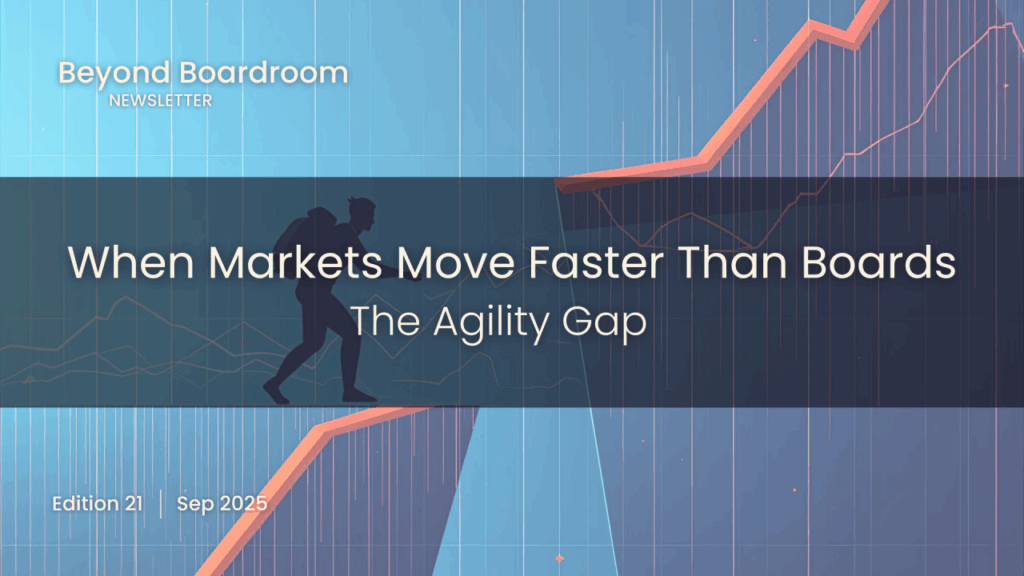
This is the reality facing every board today. Markets move in minutes. Technology transforms overnight. Political winds shift in days. Governance frameworks, built for stability, move at a slower rhythm through quarterly cycles, formal committees, and packs that are heavy with information but slow to turn into action.
Those guardrails still matter. They prevent rash decisions and preserve accountability. But in a world of real-time headlines and constant volatility, slow structures can create a new risk: being left behind.
This is the agility gap.
The Structural Dislocation
I have seen boardrooms where the pack was out of date before the meeting began. Directors debated scenarios that had already shifted. Decisions arrived too late to matter.
This is not a failure of directors. It is a failure of alignment. The cadence of governance does not always match the tempo of external reality.
The question is no longer whether boards should remain careful and thorough. The question is whether they are still fit for the speed of today.
Agility Is Deliberate, Not Disruptive
Agility does not mean abandoning rigour. It means applying rigour at the speed reality demands.
- A Harvard Law School Corporate Governance Blog analysis shows that agile boards create conditions for flexible decision-making, candid debate, continuous learning, and external perspective. These qualities help boards turn volatility into advantage.
- Harvard Business Review reminds us that agility often comes from small, empowered interventions that cut through bureaucracy and allow timely action. Boards can learn from this by adopting structures that respond quickly to events without losing oversight.
Agility, done well, is not chaos. It is discipline at pace.
Practical Ways Boards Can Boost Agility
Boards that are adapting are doing three things differently. Each is about building agility into the system, so directors can act with confidence when the world moves faster than their agenda.
- Tiered reporting: separating routine updates from decision-critical papers, so directors concentrate on what truly matters. This simple shift protects attention and ensures time is spent on judgement, not information sorting.
- Ad-hoc decision forums: convening smaller groups to handle urgent issues such as regulatory developments, activist approaches, or emerging crises. These flexible structures create room for speed while keeping accountability intact.
- Scalable governance support: models such as CoSec-on-Demand bring in experienced governance professionals who have worked in-house and can step in immediately. This strengthens capacity during peak workloads or major transactions, providing agility without loss of rigour.
Agility is not a bolt-on. It is what connects these practices: creating a governance framework that can flex without breaking, adapt without losing integrity, and support directors to act in real time without sacrificing judgement.
The Pressures Driving the Gap
Directors are facing pressures that compound quickly.
- Geopolitical shocks: sudden changes in trade policy or sanctions can reshape markets overnight.
- Technology disruption: AI, cybersecurity, and digital transformation alter business models at speed.
- Regulatory change: new requirements on climate disclosure, audit, and risk oversight continue to expand.
- Investor activism: increasingly vocal shareholders demand rapid responses and visible accountability.
A Deloitte/Wall Street Journal review of 2024 governance trends found that these pressures are intensifying and stretching traditional governance models.
Meanwhile, Oliver Wyman via the World Economic Forum describes an agile board as one that is forward-looking, exploratory, and capable of pivoting through small, rapid steps rather than waiting for certainty.
The pressure is real. The clock is relentless.
Quality and Responsiveness Must Coexist
Speed without standards is chaos. Rigidity without responsiveness is irrelevance. True governance resilience lies in holding both.
Directors need frameworks that allow for quick response when required, while preserving the transparency and accountability governance demands. And Company Secretaries must anticipate when the usual rhythm will not be enough, designing mechanisms that keep decision-making aligned with reality.
The Imperative
In a world of instant commentary and real-time markets, boards cannot afford to be the last to act. Governance must be both steady and swift.
Bridging the agility gap is not about chasing headlines or cutting corners. It is about building governance that can absorb shocks, adapt to change, and guide organisations with pace as well as prudence.
The future of governance is not only about stability. It is about resilience through agility. Without it, boards risk watching decision-making power shift elsewhere to investors, regulators, or competitors. With it, they lead.
What is CoSec-on-Demand?
CoSec-on-Demand is a flexible governance support model designed for boards and leadership teams that need immediate, practical expertise. It provides experienced governance professionals who have worked in-house and can step in quickly to expand capacity, guide major projects, and strengthen decision-making without disruption.
Boards that adapt will thrive. Those that do not will be left behind. Let us make governance the bridge, not the barrier,