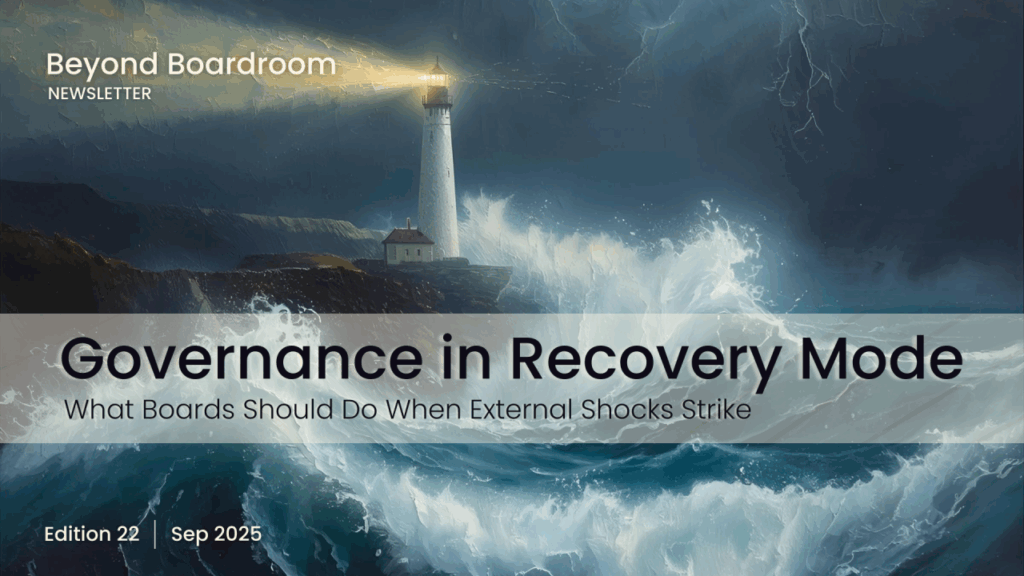
Crises do not send invitations. They arrive unannounced: a cyberattack that locks systems, a supply chain that grinds to a halt, inflation that eats margins overnight. In those moments, strategy alone is not enough. Boards are tested on resilience.
The boardroom becomes the nerve centre. What is decided there will echo for years.

The Tension: Continuity or Renewal
Every board in recovery faces the same fork in the road. Do we hold the line, or do we reset?
Continuity promises stability: trusted leaders, familiar processes, steady hands in the storm. Renewal offers fresh thinking, new energy, and a chance to reset culture and priorities.
Neither is always right. Neither is always wrong. The danger lies in clinging to continuity out of fear, or rushing to renewal without support. The test of governance is to weigh each path against one measure: will it build long-term value and trust?

Priorities for Boards in Recovery
1. Anchor in transparency and accountability
Investors, employees and regulators will not forgive concealment. Reporting must be candid. Accountability must be visible. Corrective actions must be shown, not hidden.
2. Reassess board composition and leadership fit
Crisis changes the equation. A cyberattack at Marks & Spencer wiped hundreds of millions from profit forecasts and saw its digital chief depart. It showed the board’s composition was suddenly out of step with reality. Boards must ask whether their directors bring the expertise this new world demands.
3. Strengthen risk oversight
Shocks reveal blind spots. Strengthen scenario planning. Stress test harder. Use governance to prepare for the next strike before it comes. Board Agenda warns that UK companies remain exposed on cyber. MIT Sloan and the Stanford Social Innovation Review show how scenario planning can surface invisible risks if boards have the discipline to use it.
4. Balance short-term fixes with long-term renewal
The easy mistake is to patch the hole and move on. The harder task is to embed the lesson. Governance means ensuring the urgent fix feeds into strategy, culture and capital allocation. Broadcom makes the point clearly: resilience is not only defence, it is the ability to move at pace while staying in control.
5. Engage shareholders early and often
Investors do not want gloss. They want truth. Show the trade-offs. Explain the choices. Demonstrate that decisions, whether to hold or to renew, serve long-term value.

The Board as a Signal of Resilience
Boards do more than decide. They signal. Retain a chair beyond governance code limits and the signal is one of continuity. Change a CEO in turbulence and the signal is one of renewal. These choices ripple far beyond the company. They shape confidence in the market, morale in the workforce, and the scrutiny of regulators.
In recovery mode, perfection is not possible. What matters is clarity. What matters is credibility. What matters is courage.

The Last Word
Boards that adapt will not only survive external shocks. They will turn them into moments that strengthen trust and sharpen strategy. That is the essence of governance in recovery: converting disruption into resilience.
At Beyond Governance we see this every day. Our work is to help boards redesign reporting, test resilience, and create the agility to act with confidence when the pressure is highest.
Recovery is not about returning to what was. It is about governing with the clarity and resilience to face what comes next.
Until next time, keep governance steady and resilient.
Erika Eliasson-Norris