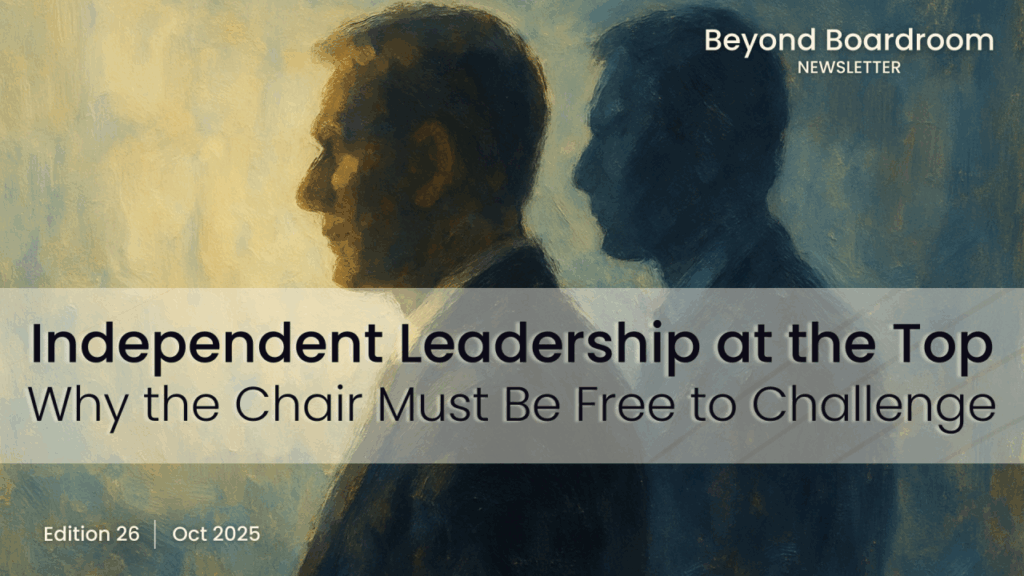
Power concentrates quietly. One title becomes two. Two voices become one. Meetings run on time, papers read well, and markets nod along. Then a harder question arrives: when the pressure rises, who holds the line with the chief executive, and who holds it for the owners?
In board leadership, equilibrium is everything. Too much control in one pair of hands and the system becomes brittle. Too much diffusion and it drifts. The strongest boards are built on tension handled well. That is why the case for an independent chair, or at the very least a truly empowered lead independent director, deserves renewed attention.
In the United Kingdom, the position is clear. The UK Corporate Governance Code states that the roles of chair and chief executive should not be exercised by the same person, and that a chief executive should not become chair of the same company. This is not a technicality but a principle designed to preserve challenge and protect confidence. The FRC’s guidance reinforces this point: oversight must be visibly independent.
Other markets have been slower to evolve. The United States has long accepted the combination of chair and chief executive roles, often offset by the presence of a lead independent director. Yet even there, momentum is shifting. Independent chairs and stronger lead directors are more common than they were a decade ago, and investor scrutiny has intensified. Spencer Stuart’s Board Index shows the steady rise in split roles, while proxy advisers continue to press major firms such as Goldman Sachs to separate leadership functions (Reuters, MarketWatch).
The logic behind separation is simple. A board exists to appoint, support, challenge, and, if necessary, replace the chief executive. When the person leading the board is also the one being overseen, a conflict sits at the centre of the system. The Harvard Law School Forum on Corporate Governance and other scholars have debated the performance impact for years. While some studies find limited market benefit, few dispute the importance of independence as a safeguard for accountability.
Globally, the OECD’s Principles of Corporate Governance (2023) avoid prescribing one model. Instead, they emphasise balance, transparency, and effective leadership. Where ownership is dispersed and executive power strong, an independent chair or an equally strong counterweight becomes part of the architecture of trust.
What the data and practice show
Evidence on performance is mixed. The Harvard Business School found that firms which split titles in response to pressure often underperformed compared with those that planned the change strategically. Structure alone is not enough. Separation only adds value when it is coupled with real independence, clear roles, unfiltered access to information, and space for honest discussion.
When designed well, an independent chair strengthens a board’s grip on succession, remuneration, and crisis oversight. A lead independent director can do the same if their authority is real rather than symbolic.
Investors now frame the question differently. Does the board have a leader who can set the agenda, seek information beyond management’s line of sight, convene non-executive sessions, and challenge decisions without fear or favour? These are the questions that matter when the stakes are highest.
Where risks concentrate when titles combine
Boards often underestimate the quiet risks that arise when one person holds both titles. Three are most common:
- Agenda control: The chair shapes the conversation. When delivery and oversight sit together, sensitive issues can arrive late or not at all.
- Information asymmetry: Even the most well-intentioned leaders filter. A separate, independent chair can ask internal audit, the company secretary, or external advisers to bring unvarnished analysis to the table.
- Succession and evaluation: A combined role blurs how the board assesses performance and plans for change. The person setting objectives is the same person being measured. When stress comes, the system falters.
The US pivot and the rise of the Lead Director
Although many S&P 500 boards still combine roles, independent chairs and lead directors are becoming more common. Spencer Stuart’s MidCap Index shows that lead directors now have authority to approve agendas, call executive sessions, and engage directly with shareholders. The Harvard Forum’s proxy reviews confirm that the demand for independent leadership is rising.
The lesson is simple. If a board chooses to keep both titles combined, it must treat the lead independent director as if they were the chair. That means full access to the company secretary, internal audit, and external advisers. It also means visible engagement with shareholders. Confidence in leadership cannot be declared. It must be earned.
What effective boards do
From my work with boards across sectors, five actions make the difference:
- Define the split in writing: Role descriptions for the chair and chief executive should be specific, current, and shared with the full board. If there is a lead independent director, their authority should be defined with the same precision. The Financial Reporting Council’s guidance on the chair’s independence at appointment and the division of responsibilities remains a valuable anchor. (FRC guidance)
- Protect information rights: Independent board leaders must have the authority to commission analysis outside the management pipeline. This ensures the conversation remains honest and decisions are informed by unfiltered insight rather than presentation.
- Hold non-executive sessions: Time without executives present is not disrespectful. It is a hallmark of strong oversight. Non-executive sessions should be a standing feature, not an emergency measure. These sessions give independent directors space to speak openly, test the quality of information, and assess whether management challenge is genuine. They should be a regular feature, minuted by the Company Secretary, and followed by clear feedback to the chief executive. When handled well, they strengthen trust and sharpen board judgment.
- Link structure to succession: If the titles are currently combined, define the trigger and pathway to separation at the next transition. The Conference Board’s 2024 Succession Report shows how fragile leadership handovers can become when boards postpone the hard design decisions. Here is some supporting data.
Engage owners on leadership design: The best boards do not wait for proxy season to explain why their structure works. They engage across the year, making visible how independence is preserved in practice. When investors feel heard and see evidence of accountability, confidence follows naturally.
The British Lens
The British model remains pragmatic. The chair should be independent upon appointment and separate from the executive. Boards that treat the UK Corporate Governance Code (2024) as a living framework rather than a compliance box tend to manage crises more effectively and handle transitions with greater calm.
The last measure
Leadership at the top should feel like a balanced pull in both directions. The chair protects the chief executive from noise but also resists overreach. When that balance holds, organisations move with speed and stability. When it fails, trust disappears.
Separation is not a universal cure. What matters is whether independence is real. A separate chair who cannot shape the agenda has independence in name only. A combined chair and chief executive can work if a trusted, empowered lead director provides genuine counterbalance. The real test is whether the board can have the hardest conversation freely, early, and with consequence. If yes, confidence follows. If not, structure must change before events force it.
At Beyond Governance, we help boards turn independence into practice: clear roles, defined information rights, and disciplined meeting routines. Our approach builds investor dialogue that treats owners as partners in foresight rather than critics in hindsight. Independence does not slow decision-making. It strengthens it.
Until next time, keep leadership at the top balanced, visible, and strong.