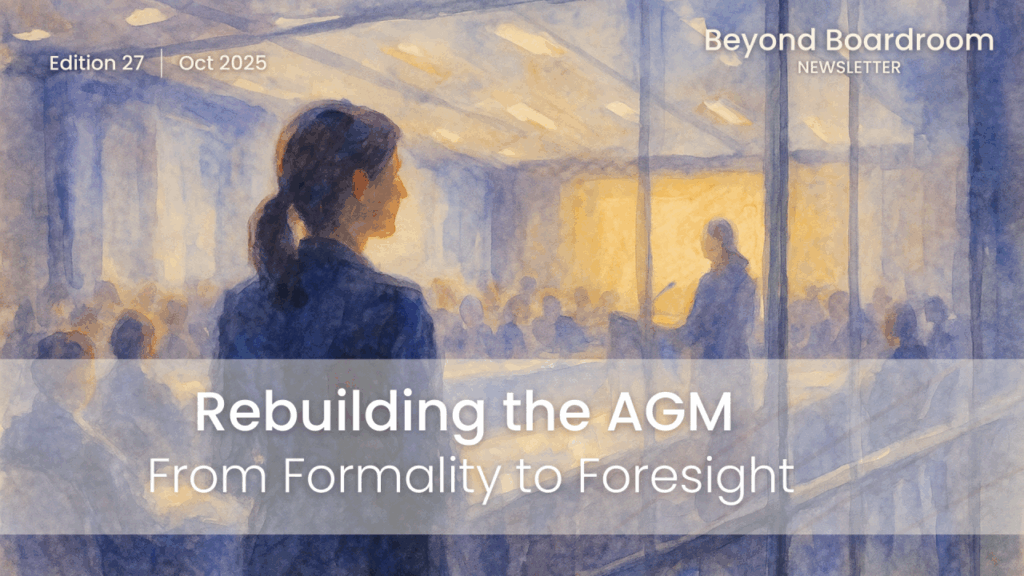
The annual general meeting was once a stage. The script was predictable, the votes pre-determined, and the questions rehearsed. Yet that formality feels increasingly out of step with the world it serves.
Digital shareholders, activist funds, and proxy advisers have rewritten expectations. They want answers that reach beyond the slide deck and a dialogue that extends beyond the ritual. The AGM is no longer a compliance exercise; it has become a mirror of culture and conduct, a moment when companies reveal how they listen, learn, and lead.
Boards with real foresight now treat the AGM as a living measure of tone and transparency. It is where integrity becomes visible. The question for every chair and chief executive is no longer how to present well, but how to connect with credibility.
A Format Under Strain
Across markets, boards are rethinking what a modern AGM should be. The pandemic forced a digital experiment, but the hybrid format is here to stay. Virtual participation has broadened access but often flattened dialogue. The challenge is no longer logistical; it is relational.
Investors want to feel seen, not streamed. They expect technology to enhance accountability, not replace it. Boards are learning that digital connection means little without genuine exchange. Questions must be heard, answered, and acknowledged, not filtered by software that turns dialogue into data.
Recent analysis shows that investors now judge boards as much by their tone as by their numbers. How a company manages its AGM – who speaks, who listens, and who answers directly – signals as much about leadership as the results themselves.
The New Shape of Shareholder Voice
Shareholders no longer view the AGM as their only point of contact. Digital briefings, ESG updates, and investor calls now hold equal weight. But broader access has raised expectations for coherence.
When the message shared in an AGM conflicts with what is said elsewhere, trust erodes quickly. Investors remember tone more than transcripts. Boards that approach the AGM as an open conversation, not a staged event, build credibility that lasts long after the webcast ends.
In the United Kingdom, the Financial Reporting Council’s guidance encourages companies to engage continuously rather than episodically. Dialogue, when treated as a rhythm instead of an obligation, becomes a source of resilience.
Evidence from the OECD Corporate Governance Factbook supports this: markets that maintain active shareholder communication show higher transparency, stronger investor confidence, and steadier long-term performance.
Why the Format Still Matters
Structure shapes behaviour. The design of the AGM – from who opens the meeting to how questions are prioritised – communicates more than most realise.
Boards that over-curate risk signalling defensiveness. Those that allow genuine spontaneity project confidence. Chairs who open the floor to unfiltered questions often find that investors value honesty over control.
Hybrid AGMs pose another test: do remote participants feel involved or invisible? Inclusion demands more than access. It requires equal footing. Companies that use live polls, visible acknowledgments, and real-time Q&A are redefining what transparency looks like in the hybrid era.
A global review found that investors increasingly assess leadership by how it handles disagreement in public, not by how well it manages the choreography. The performance of listening has given way to the discipline of it.
Lessons from the Field
From my work with chairs, non-executives, and company secretaries across sectors, four lessons stand out:
1. Build the AGM for dialogue, not display.
Keep presentations short and allocate real time for live questions. Credibility grows when the board listens more than it speaks.
2. Treat preparation as cultural, not procedural.
Rehearse clarity, not choreography. Authenticity cannot be scripted. When boards over-manage their message, they lose their ability to think and respond in real time, and investors can sense it.
3. Hold non-executive sessions before and after.
These sessions give independent directors space to reflect on what they heard, how they responded, and whether management’s tone matched its intent. Time without executives present is not disrespectful; it is essential for perspective and candour.
4. Close the feedback loop.
Publish a concise post-meeting note summarising key themes and next steps. It shows that challenge travels through the system and that investor input has consequence.
Why Chairs and CEOs Should Care
The AGM has become a test of posture. For the chair, it shows how composure holds under pressure. For the chief executive, it reveals whether conviction can coexist with humility.
Boards that handle scrutiny well reinforce confidence. Those that deflect or manage defensively raise questions about culture.
The most effective leaders approach shareholder dialogue with discipline and curiosity. They recognise that good questions are not interruptions but opportunities — moments when accountability becomes visible. Investors rarely expect perfection, but they always recognise presence.
The Last Measure
The AGM is no longer a performance but a pulse check on tone and transparency, a moment that reveals not what is rehearsed but what is real.
For those who lead, the task is not to modernise the meeting but to make it matter. Shareholder dialogue is not a test of authority; it is proof of it.
Listening is not a courtesy; it is a discipline. The AGM is where boards earn credibility one question at a time.
At Beyond Governance, we help boards turn engagement into insight, designing meetings that replace performance with presence and management with maturity. Real leadership is not about control. It is about the confidence to be questioned.
Until next time, may your next meeting leave investors not only informed but assured.
Erika