A Market at a Turning Point
The City still wakes before dawn, espresso machines hiss, and sharp-suited analysts stride across London Bridge as if they own the sunrise. Yet behind the bustle, the London Stock Exchange is nursing a quiet identity crisis. IPO volumes are half what they were in 2019, and UK pension funds now allocate barely four per cent of assets to domestic shares. Every time a board decides to list abroad, we lose more than a ticker symbol; we lose a chance to shape how that company grows up.
I explored the governance‑readiness angle in depth back in April’s Beyond Boardroom Edition 6, “London Listings Need a Governance Wake‑Up Call.” That piece argued boards must raise their own bar before regulators raise (or lower) theirs. Today I want to widen the lens. Regulation is one lever, readiness another but the real differentiator will be whether London can reinvent the very experience of being a listed company. Think governance not as gatekeeper, but as product design. That calls for fresh, even playful ideas so let’s get specific.
What the CBI Proposes and Why It Matters
Enter the Confederation of British Industry, stage left, with a twenty‑point plan and just enough dramatic flair to keep the press awake. Three proposals deserve front‑row seats:
- Tax‑deductible IPO costs so scale‑ups stop flinching at the London price tag.
- Scrapping stamp duty on share trades because liquidity behaves like oxygen; cut it off and everything turns blue.
- Rebalanced stewardship that obliges large shareholders to talk before they sulk. Passive capital is useful, but silent capital is useless.
Together these tweaks aim to plug the leakage of listings and restore London’s swagger. The question is whether swagger alone will do the job.
Governance: Barrier or Flywheel?
Rules are like shoes: too tight and no one wants to dance; too loose and someone twists an ankle. The CBI floats the idea of performance‑linked pay for non‑executive directors. Independence must stay sacred, yet some alignment could sharpen focus on growth. Think five‑year vesting or climate‑linked metrics. The point is to turn governance from hall monitor to track coach. Oversight should set the pace, not wave a red card after the sprint is over.
Four Lateral Moves Britain Could Lead
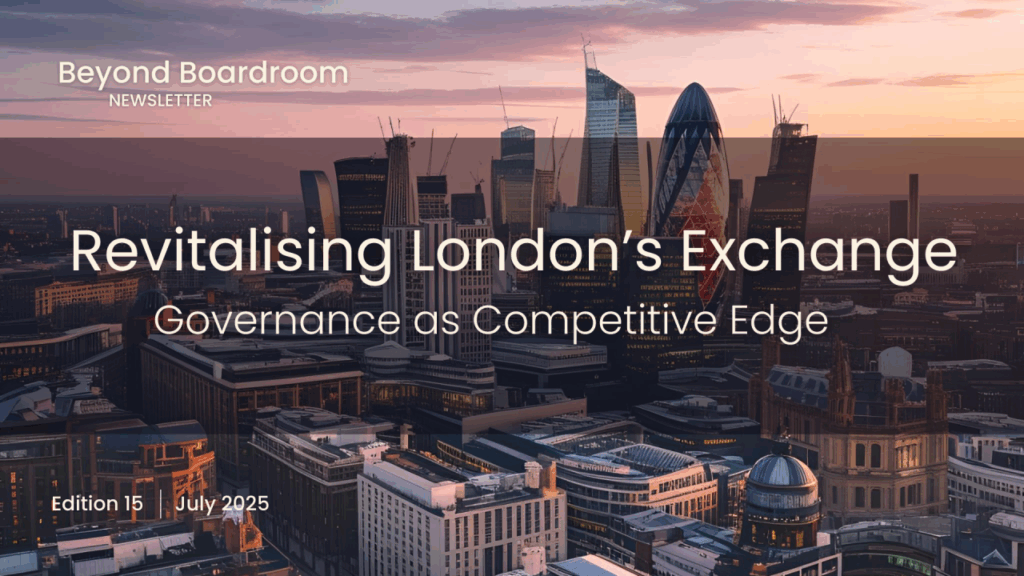
Picture the skyline at dusk, glass towers shimmering above Victorian brick. When I look at that horizon, I do not see decline; I see scaffolding for the next act. London’s edge has never come from imitation. It comes from inventing structures the world later borrows.
Four moves to set the pace
- IPO Sandbox – a two‑year proving ground where newly listed firms pair with veteran chairs, culture coaches and maybe the odd behavioural scientist. Real‑time learning, real‑time data.
- Stewardship Scorecards – a public dashboard that ranks asset managers on engagement depth. Polite ghost‑voting will no longer pass for stewardship.
- Regulatory Design Sprints – five‑day policy hackathons where regulators, issuers and investors hammer out rule prototypes using live market data. Fewer unintended consequences, fewer dusty PDFs.
- Governance Innovation Grants – seed funding for audit analytics, ESG assurance tech and stakeholder‑sentiment mapping. If fintech reinvented payments, gov‑tech can reinvent oversight.
None alone will flood the calendar with IPOs, yet together they shift the story from patch‑up to reinvention. They tell founders that London does more than list shares; it co‑creates the governance environment where companies can thrive.
Investor Confidence and the Virtuous Loop
Good governance is a flywheel. When boards know investors will ask tough, informed questions, they plan beyond the next quarter. That long‑range thinking attracts global capital that prefers resilience to roulette. Lower cost of capital encourages more listings, and the loop spins faster. Governance is not a watchdog, it is the starter motor of that virtuous cycle.
Questions Policymakers Must Ask Now
London has a rare window. Momentum can vanish in the fog of consultation, so we need to keep the spotlight on first‑principle questions:
- Which single rule, if redesigned today, would deliver three credible IPOs within a year?
- How do we prevent new flexibility from eroding minority‑shareholder rights? There is no point filling the pool if we punch holes in the liner.
- Should success be tallied by IPO count alone, or by five‑year survival and genuine value creation?
Answer these candidly and reform becomes launchpad rather than talking point.
Conclusion: Markets as Mirrors
Markets mirror the values we encode into them. London built its reputation on trust and a slightly cheeky refusal to sit still. Sell world‑class governance as the premium, strip out friction that adds no public value, and we build an exchange that is both dynamic and dependable. The alternative is to wait while other centres write the next chapter.
If you would like to explore these ideas further, you are welcome to join my book reading in London on 24 July or the Governance with Grit webinar on 28 July. Registration links are available here.
Onwards in governance and grit,
Erika