In City boardrooms, a new question is creeping onto the agenda. It’s not just about growth targets or market opportunities anymore. It’s this: Can we trust the rules to be the same tomorrow as they are today?
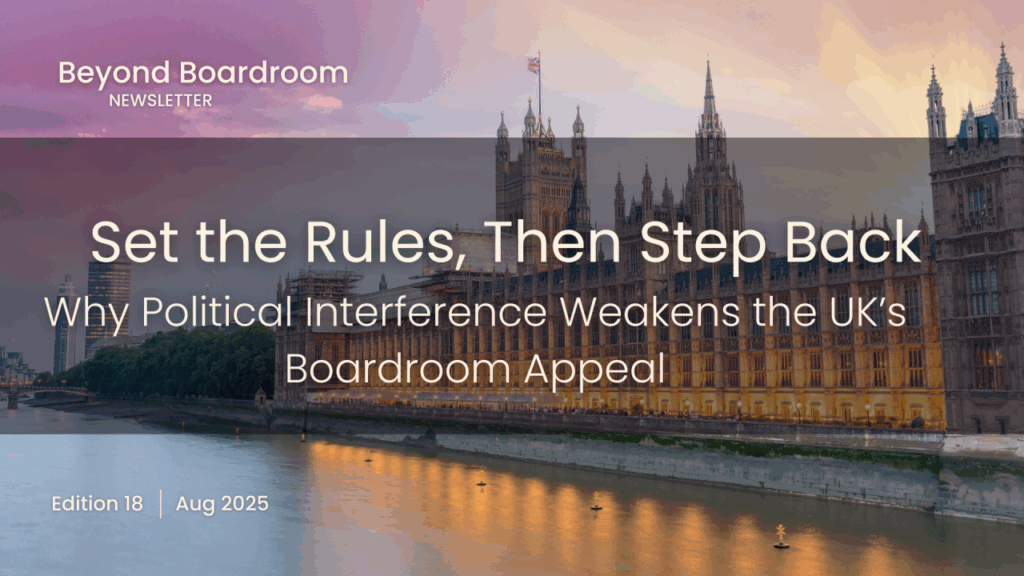
For decades, the UK has traded on a promise: a stable, rules-based economy where independent referees make the calls, even when they’re politically inconvenient. That promise is part of our competitive advantage. Yet it’s starting to fray. When ministers step into individual regulatory decisions, they replace certainty with doubt – and that makes the UK less attractive for companies to list, invest, or grow here.
The Governance Principle at Stake
Think of a match where the rules are clear, the referee respected, and the outcome trusted. Now picture the owners stepping in mid-game to “clarify” the rules because they dislike the score. That’s what happens when governments cross the line from setting policy to influencing individual cases.
Independent regulators are not obstacles; they are guardians of predictability. They’re the reason a pharmaceutical company will invest billions in UK R&D without fearing sudden changes, or why a fintech will pursue a UK listing without worrying about late-stage conditions. As Times columnist David Wighton argues, “ministers can shape frameworks, but once set, they must keep their hands off.” The moment politics hovers over the referee’s whistle, the game changes.
Why Investor Confidence Needs Consistency
Investors read the market like a weather chart. Consistency in how rules are applied allows them to plan for the long term. Once they sense political winds could change the outcome, their risk appetite drops.
I’ve been in boardrooms where the conversation has shifted from strategy to survival: What if the regulator is pressured to change course? Do we fight it or quietly adapt? Those are not the conversations of a confident market.
Current Flashpoints in the Headlines
The past few months have made the problem visible.
- AstraZeneca, the UK’s most valuable listed company, has hinted it may move its listing to the NYSE. Publicly, the dispute is over NHS drug pricing. Privately, it’s also about whether pricing rules can be altered by political pressure.
- Revolut, a fintech seen as a UK success story, has faced prolonged delays in getting its full banking licence. Ministers reportedly tried to broker meetings to speed things up. Bank of England Governor Andrew Bailey refused – an important defence of independence, but one that shouldn’t have been necessary.
These moments may seem isolated, but each one plants a seed of doubt in the minds of global investors.
Lessons from Abroad
The same pattern is visible elsewhere. In the United States, antitrust reviews have become bargaining chips in political negotiations. The Hewlett Packard Enterprise–Juniper Networks deal is a recent example, where regulatory review became entangled in wider political trade-offs.
Once political intrusion is normalised, it’s hard to reverse. Investors begin to price in that uncertainty – and move their capital elsewhere.
The Governance Line Ministers Shouldn’t Cross
Governments should set the rules of the market. That’s their job. But once those rules are in place, they must be applied impartially. Even well-intentioned interference sends the message that outcomes are negotiable for those with enough influence.
When that happens, companies stop asking “How do we innovate within the rules?” and start asking “How do we influence the rule-maker?” That shift is corrosive.
A Call for Restraint in the National Interest
If the UK wants to attract more listings, win back IPOs from New York, and remain a magnet for global capital, it must recommit to restraint. Set the framework – then step back. Defend independence, even when decisions are unpopular.
Our competitive edge was built not on loud ministerial announcements, but on the quiet, steady application of clear rules. That is governance resilience. And it’s a strength worth protecting.
Until next time, let’s keep governance steady – and let the rules do their job,
Erika.

Erika Eliasson-Norris is the author of The Secret Diary of a Company Secretary, a candid and thought-provoking reflection on the realities of boardroom life, written to spark conversation and drive change across the governance profession. She is also CEO of Beyond Governance, where she advises boards, executives, and founders on building resilient governance structures that support long-term growth and institutional integrity. Erika serves as an Independent Assessor for the Post Office Horizon IT Inquiry, bringing her governance expertise to one of the UK’s most significant institutional accountability reviews.
The Secret Diary of a Company Secretary is available for preorder: https://thesecretdiaryofacompanysecretary.co.uk/
#GovernancewithGrit #GovernanceResilience #BeyondBoardroom