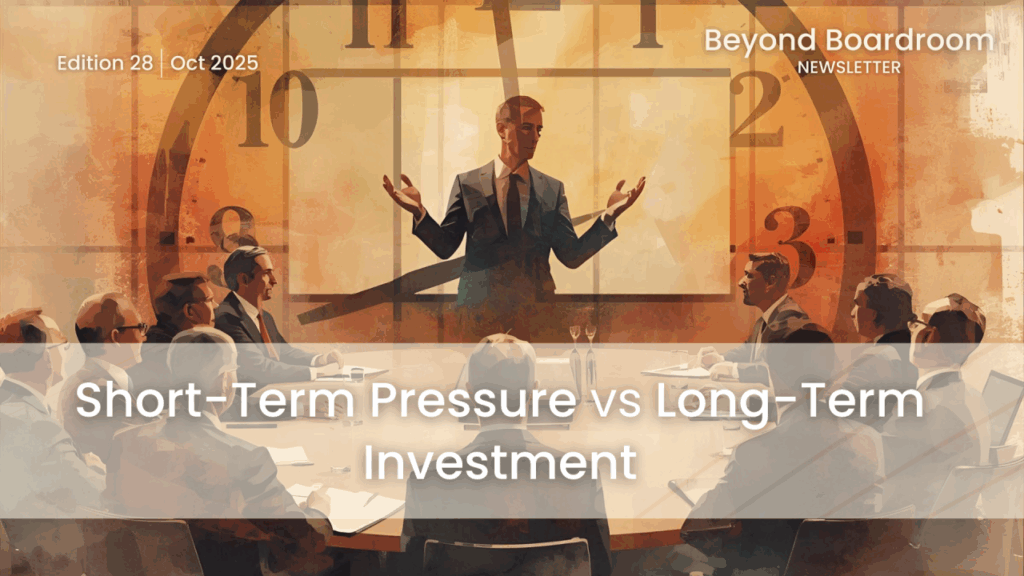
Markets speak in seconds. Leadership thinks in seasons. The challenge for every board is knowing which voice to answer.
Every quarter brings a new earnings call, a fresh analyst question, and another set of short-term expectations dressed as long-term interest. The market demands clarity while the board seeks confidence. Somewhere between the two, strategy becomes negotiation.
Yet leadership is not about keeping pace with markets. It is about knowing when to resist them.
When short-term pressure overwhelms long-term purpose, even the best-run companies begin to tilt. The symptoms look like progress: ambitious targets, accelerated returns, and higher dividends. But underneath, investment slows, innovation thins, and resilience erodes.
That is the real cost of impatience.
The Perverse Incentive
Research shows that many chief executives face greater risk from missing a quarterly forecast than from underinvesting in the future. Incentives are still heavily weighted toward short-term performance metrics, even when boards claim to prioritise sustainability and growth.
A recent analysis of S&P 500 pay design found that more than seventy percent of CEO remuneration remains tied to one- and three-year targets. Only a small fraction extends beyond that horizon. The result is predictable. Investment projects that take five – or -ten years struggle for oxygen.
The system rewards visibility over value. Capital flows to what can be measured, not necessarily to what matters.
The strongest boards I have seen confront this bias early. They define performance through resilience as well as returns. They measure the health of the business model, not just its speed. And they remember that what gets rewarded gets repeated.
The Market’s Memory Problem
Short-termism is not new, but the digital age has magnified it. The immediacy of information means every investor, journalist, and algorithm reacts in real time. A small earnings miss can erase billions in market value within hours, while long-term gains arrive too slowly to be noticed.
Studies show that listed companies under pressure from quarterly guidance reduce capital expenditure by up to twenty percent compared with peers who do not issue it. The findings are consistent across sectors: firms that focus on long-term metrics deliver stronger revenue growth, profit margins, and job creation over a ten-year period.
It is not that investors reject long-term value. It is that they rarely see enough of it disclosed clearly enough to trust it.
Boards can correct that imbalance by communicating strategy through the lens of time rather than tactics. Explaining how near-term volatility serves a larger arc of growth signals maturity to investors and confidence to employees.
The irony is that markets often reward courage once they recognise it. The danger lies in assuming they will see it without help.
The Board’s Blind Spot
Every board agenda claims to balance short-term results with long-term goals. Yet when a crisis arrives, the urgent often displaces the important. Capital discipline becomes cost cutting. Purpose becomes messaging. Long-term strategy slides down the page.
The board’s role is not to eliminate short-term focus but to contain it. That begins with time allocation. If half of every board meeting is spent reviewing the last quarter’s numbers, the long-term plan is already losing. The agenda must reflect the horizon the board says it values.
Another blind spot lies in how boards frame risk. Too often, risk registers capture operational shocks but ignore strategic decay. Declining innovation capacity, cultural fatigue, or dependency on one market rarely trigger red flags because they do not explode; they erode. By the time they surface, the options are narrow.
Boards that measure time-to-impact rather than probability tend to spot these weaknesses early. It is a different kind of risk literacy, one grounded in stewardship rather than firefighting.
Investors Want Patience, If You Explain It
The assumption that investors are short-term by nature is only half true. Large institutional shareholders increasingly call for disclosure on long-term planning, talent development, and climate transition. What frustrates them is opacity, not ambition.
In the OECD Principles of Corporate Governance 2023, investors cited weak narrative reporting as one of the biggest barriers to supporting long-term investment. When boards fail to show the link between today’s cost and tomorrow’s resilience, they lose the confidence that buys time.
Transparency is not just about data. It is about storytelling that connects metrics to meaning. A board that can articulate how investment in new technology, people, or markets sustains competitiveness over time earns permission to think beyond the quarter.
The Stewardship Mindset
Some of the best examples of long-term discipline come from family-controlled and mission-driven companies. Their leaders view time as an asset rather than a constraint. They make decisions with a generational lens, not a quarterly one.
Public companies can learn from that mindset without abandoning accountability. The mechanism is board design. Committees that integrate sustainability, strategy, and remuneration align incentives across timeframes. Succession planning that rewards continuity of values rather than tenure of results ensures that long-term investment survives leadership turnover.
None of this requires radical reform. It requires repetition. A board that insists on reviewing long-term performance at every meeting slowly rewires its culture. The discipline of asking “Will this still matter in five years?” changes how directors think.
The Last Measure
Patience is not a luxury in business. It is a form of strength. The board’s duty is not to resist markets entirely but to hold the horizon steady when the noise grows loud. Markets reward confidence more than compliance.
The healthiest companies understand that resilience compounds quietly. A quarter can destroy or redeem a reputation, but decades build legacies. The most credible boards treat short-term scrutiny as the cost of long-term conviction.
At Beyond Governance, we work with boards that want to protect that conviction. By aligning incentives with stewardship, connecting strategy to purpose, and embedding foresight into every decision, boards strengthen not just performance but perspective.
Because lasting value is never created by speed alone. It is created by direction that endures.
Erika.

Erika Eliasson-Norris is the author of The Secret Diary of a Company Secretary, a candid and thought-provoking reflection on the realities of boardroom life, written to spark conversation and drive change across the governance profession. She is also CEO of Beyond Governance, where she advises boards, executives, and founders on building resilient governance structures that support long-term growth and institutional integrity. Erika serves as an Independent Assessor for the Post Office Horizon IT Inquiry, bringing her governance expertise to one of the UK’s most significant institutional accountability reviews.