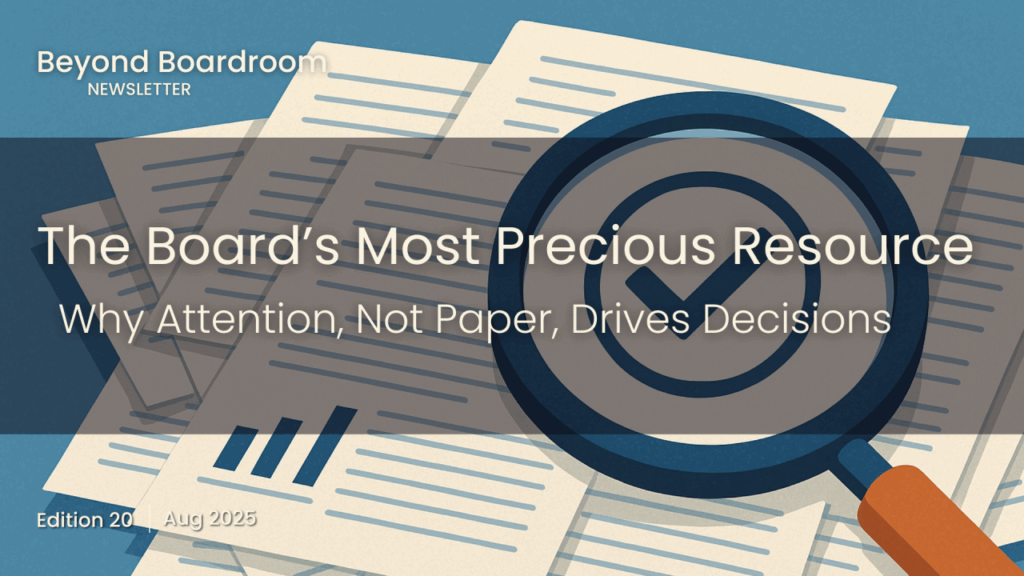
In every boardroom, there is one resource more valuable than capital, more finite than time, and more fragile than reputation: the collective attention of its directors.
It is attention that shapes the questions asked, the priorities debated, and the decisions made. Yet it is also the resource most often squandered, drowned in paper, crowded out by unfocused reporting, and lost in the noise of too much information.
Board reporting should focus that attention. Instead, it too often disperses it. As The Chartered Governance Institute UK & Ireland makes clear, the purpose of a board pack is not to contain everything but to equip the board to make confident, timely, and well-informed decisions.
Why Traditional Board Packs Fail
The most common failings are not unique to any one sector. Reports are written to record, not to guide. They provide background without direction, data without interpretation. Decision points are buried deep in the text, obscured by operational minutiae and internal jargon. The FRC’s Annual Review of Corporate Governance Reporting flags the need for more concise, outcomes-focused disclosure and sharper reporting on risk management and internal controls.
In some organisations, the board pack has become a catch-all archive, a comfort blanket of completeness that comes at the expense of clarity. Directors can end up spending their most valuable resource, their focus, on working out what the question actually is.
The Company Secretary as Custodian of Focus
Here the Company Secretary’s (CoSec) role is pivotal. The CoSec is not merely a conduit for information but a custodian of the board’s attention. This requires discernment: deciding what earns the board’s focus and what belongs in the supporting material.
A skilled CoSec asks:
- Does this align with the board’s strategic priorities?
- Does it frame the “so what” of the data?
- Will directors be able to reach a confident decision within the meeting time?
As McKinsey & Company notes, the quality and focus of pre-read materials are among the strongest predictors of a board’s performance in the room.
Balancing Detail with Brevity
Brevity is not about stripping away substance. It is about revealing it. The IFC’s Board Leadership in Action advises that decision papers should place the key point upfront, bring risks and recommendations to the fore, and keep deep technical material in appendices.
As Churchill understood, making something shorter often requires more effort than making it longer. Distilling complexity into a clear, concise paper is a craft that requires both rigour and empathy for the audience.
Raising the Standard
Some high-performing boards are now using tiered reporting systems, where routine updates are distributed separately from decision papers, and dashboards distil performance and risk into a single page. This approach, highlighted in PwC’s Board Effectiveness: The Reporting Challenge, keeps meeting time centred on judgement, not information retrieval.
The goal is simple: protect the board’s attention. Once lost, it is hard to regain. In governance, the quality of the conversation determines the quality of the decision and ultimately the direction of the organisation.
The Call to Action
At Beyond Governance, we have worked with boards and Company Secretaries across sectors to redesign reporting frameworks that sharpen focus, reduce volume, and elevate decision-making. If your board pack feels like a library rather than a compass, it may be time to rethink it.
We would be delighted to share what works.
Until next time, guard your board’s attention as you would its reputation; both are hard to win, easy to lose, and impossible to buy back.