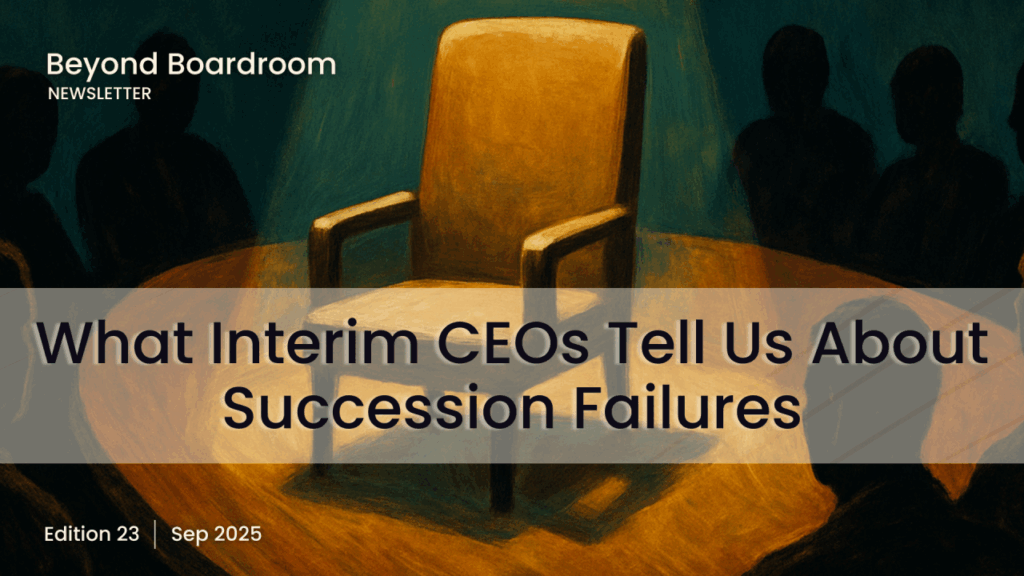
When a company announces an “interim CEO,” it marks a moment of transition. Sometimes it is the calm hand that steadies the business. Sometimes it is the bridge to a new phase of growth. And sometimes it is a signal that succession planning has not kept pace with the organisation’s needs.
Markets watch closely. An interim appointment raises questions. Is this continuity by design, or improvisation under pressure? Has the board anticipated change, or is it reacting to it? The answer tells investors much about the quality of governance at the top.
Why Interim Leaders Matter
An interim CEO is not always a sign of failure. Unexpected shocks happen. Health issues, reputational crises, even sudden shifts in strategy can demand a temporary solution. A well-chosen interim can reassure employees, keep strategy moving, and give the board space to make a thoughtful decision about the future.
But when “interim” becomes the default, it can erode confidence. Research is clear. Harvard Business Review shows that poorly handled succession destroys value while strong pipelines preserve performance and investor confidence. Forbes has argued that the rise of interim CEOs is often less about market disruption and more about boards not planning ahead. McKinsey highlights how bias narrows the field, leaving boards unprepared when a sudden transition is required.
The costs are visible. At BP Bernard Looney’s resignation in 2023 left the board relying on Murray Auchincloss as interim CEO until a permanent successor was confirmed. Analysts questioned how a strategically vital company could be caught without a ready plan. In the United States, Starbucks turned to Howard Schultz after Kevin Johnson’s abrupt retirement in 2022 (Reuters). In both cases, the interim appointment became a signal to the market of whether succession had been prepared or improvised.
The Signs of Weak Succession
From my work with boards, three warning signs stand out.
- Dependence on a single leader. When one individual becomes the embodiment of culture and strategy, the board forgets to build a pipeline.
- Succession as a formality. Annual reviews take place, but they never test real readiness.
- No contingency planning. Illness, crisis, or sudden exit – foreseeable risks yet often overlooked.
The UK Corporate Governance Code makes succession planning a board responsibility. When treated as a routine exercise rather than a stewardship duty, gaps appear quickly.
What Good Looks Like
Good governance cannot prevent shocks. But it can prepare for them.
The strongest boards treat succession as a living process. They develop leaders at least two levels below the CEO. They run scenario tests to expose blind spots. They keep external candidates under review, so options are ready. And above all, they align succession with strategy: the next leader must be able to carry the company into its future, not just its present.
Forbes highlights that inclusive succession planning strengthens pipelines by broadening perspective and diversity. In volatile markets, that breadth of thinking can be decisive.
There are good examples. At Unilever, leadership development has long been disciplined. When Alan Jope stepped down in 2023, Hein Schumacher was appointed swiftly, with no sense of drift. It showed a board not only prepared, but confident.
Why Succession Is Strategic, Not Administrative
Succession is too often mistaken for compliance. It is treated as paperwork. That is a dangerous illusion.
Succession is strategy. It is continuity of trust. It is the signal investors read when judging whether a board is thinking beyond the next quarter. Succession planning is one of the clearest signals of governance effectiveness. At Beyond Governance, we see this not as an abstract compliance exercise, but as a practical measure of whether a board is prepared to lead through disruption. The strength of a pipeline tells the market the board is thinking ahead, not just reacting to the present.
A credible pipeline tells the market: this board is looking ahead. An interim without a plan tells the opposite.
The Final Measure of a Board
In volatile markets, interim leaders will always have their place. But they should not be the default. Too often, they signal that a board has been caught reacting when it should have been preparing.
Succession is not paperwork. It is the crucible where foresight, resilience, and strategy are tested. A board’s ability to navigate leadership change is the clearest signal of whether its governance is fit for the future.
Prepared boards do more than avoid headlines. They preserve value. They steady their people. They carry momentum through uncertainty. And they give investors a reason to trust that continuity and renewal are both in hand.
That is the final measure of a board.
Until next time, let us treat leadership transitions not as a weakness exposed, but as resilience proven,
Erika Eliasson-Norris