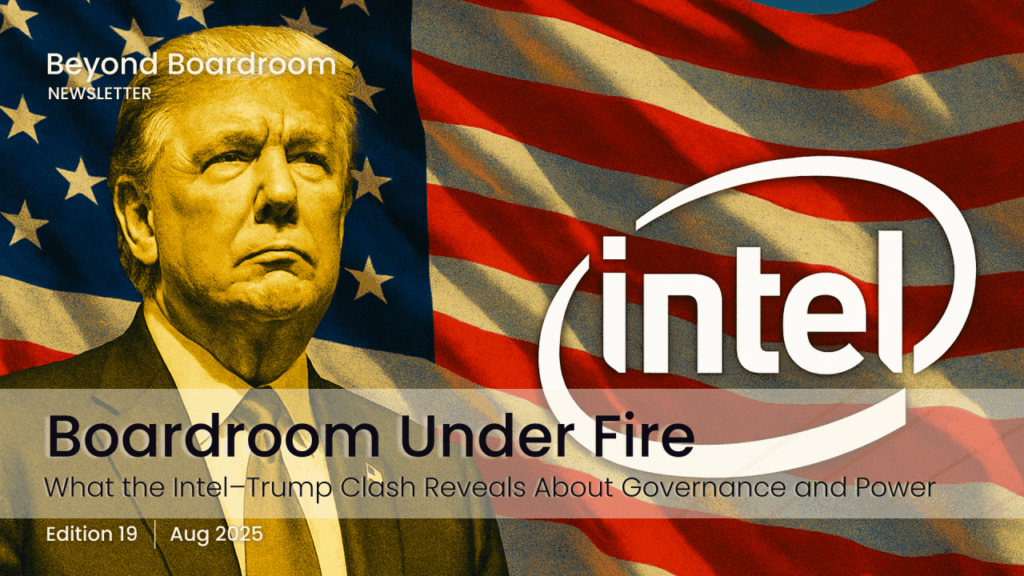
There are moments in the affairs of nations and of companies when the principles that underpin their authority are tested, not in grand halls or legislative chambers, but in the glare of public scrutiny. The present dispute between U.S. President Donald Trump and the board of Intel is such a moment.
President Trump’s public call for the resignation of Intel’s chief executive, Lip-Bu Tan, on grounds of alleged prior dealings with Chinese interests (The Guardian) may be viewed by some as merely a political skirmish. Yet, like the faint rumble of distant guns, it heralds the possible encroachment of political power into the territory of independent corporate governance. In our interconnected age, such incursions do not remain confined to the scene of their first occurrence.
The Field of Governance
Boards, like parliaments, derive their legitimacy from the trust placed in their judgement. They are not meant to yield to the tempests of personality or the shifting tides of politics. Their duty is to deliberate, to decide, and to defend the long-term interests of those they serve.
When an external figure of immense political influence seeks to unseat a leader not through the instruments of ownership or due process, but by proclamation, the precedent strikes at the foundation of corporate autonomy. As The Times might remind us in another context, the rules are made in advance so that the players cannot change them mid-game to suit their own purposes. (The Times)
The essential question, both for governments and for boards, is this: will authority be exercised through established mechanisms, or will it be bent to the will of those who shout the loudest?
The Principle at Stake
In politics, we call it checks and balances. In corporate life, we call it independent oversight. Both serve the same end: to ensure that power is restrained by process, and that decisions are not the creatures of impulse.
As Bertrand Russell once observed, “The greatest challenge to any thinker is stating the problem in a way that will allow a solution.” The problem here is not whether Mr. Tan is fit to lead Intel. The problem is whether the decision on that matter should be made by the board on its merits, or by the intervention of external political actors. Once the latter is accepted as legitimate, the former is no longer truly free.
This is not an abstract concern. Crisis communications specialists have already warned Intel that remaining silent would be “potentially fatal” in such a high-stakes public confrontation (Business Insider). Analysts at Reuters note that the company is also navigating significant operational pressures, including a multi-year turnaround strategy and costly investments in domestic chip manufacturing. (Reuters)
A Wider Horizon
It would be an error to regard this episode as confined to the United States. The same pressures, though clothed in different accents, threaten boardrooms in London, Frankfurt, and Singapore. The mingling of political agendas with corporate governance is not a passing weather front. It is a climate change in the way authority is exercised.
The challenge for those of us who care about governance is to recognise that its defence now requires both vigilance and courage. Vigilance, to discern the subtle encroachments masked as “protection” or “patriotism.” Courage, to resist them even when resistance invites criticism from powerful quarters.
Holding the Line
Intel’s directors have stood by their chief executive (Bloomberg), and in so doing have sent a message that boards must be more than decorative ornaments to shareholder meetings. They must be the guardians of process, the custodians of trust, and, when necessary, the shield against improper influence.
For governance, as for democracy, the measure of its worth lies in how it behaves when challenged. In calm seas, any ship appears sturdy. It is in the gale that we learn whether it can hold its course.
Ultimately, the question is not whether Intel can survive this storm, but whether we are prepared to defend the independence of leadership, both in commerce and in the state, against those who would seize control for themselves.
Erika.

Erika Eliasson-Norris is the author of The Secret Diary of a Company Secretary, a candid and thought-provoking reflection on the realities of boardroom life, written to spark conversation and drive change across the governance profession. She is also CEO of Beyond Governance, where she advises boards, executives, and founders on building resilient governance structures that support long-term growth and institutional integrity. Erika serves as an Independent Assessor for the Post Office Horizon IT Inquiry, bringing her governance expertise to one of the UK’s most significant institutional accountability reviews.
#TheSecretDiaryofaCompanySecretary is available for preorder: https://thesecretdiaryofacompanysecretary.co.uk/