This week I spoke to a group of Company Secretaries in New Zealand as part of the Company Secretaries Circle. We spoke about trust – how it is built, how it is quietly destroyed, and what governance professionals can actually do about it. This article picks up that conversation.
I asked those company secretaries the same question I ask directors, and the same one you can put to your own teams, when you are trying to understand where things started to shift either up or down. I ask them to: think of the best board/company you have ever served on/worked for. Not the most prestigious. The best. The one where the decisions were sound and the work felt real. What made it work?
The answer, almost without variation, is some version of the same thing.
People felt safe to say the uncomfortable thing.
That is trust. Not comfort. Not consensus. Not the absence of disagreement. Safety; the specific, earned belief that you can say what you actually think without it being used against you.
And yet, when we talk about board effectiveness, trust is rarely the word that appears first. We talk about skills matrices. We talk about composition, evaluation frameworks, paper quality, diversity of thought. Trust gets mentioned as a cultural aspiration, something desirable but essentially unmeasurable, filed alongside ‘good chemistry’ and left to look after itself.
That is not just naive. It is a governance failure.
The evidence boards are ignoring
There is no shortage of research on this. The problem is not that we don’t know, it’s that boardrooms tend to treat trust as a soft concept and therefore not a governance one.
Professor Amy Edmondson of Harvard Business School, whose work on psychological safety has shaped management thinking for two decades, is unambiguous: high-stakes teams operating without psychological safety make worse decisions, process less information honestly, and suppress the kind of challenge that prevents catastrophic failure. Boards are not exempt from this. They are arguably more exposed to it, because the social stakes of speaking up at board level are higher than almost anywhere else in an organisation.
The Financial Reporting Council’s 2023 Board Effectiveness Review found that boards with high levels of director trust in management received better quality information and demonstrated significantly stronger oversight of emerging risk. That is not a soft finding. That is a governance outcome and it lives or dies on the quality of the trust relationship in that room.
The Edelman Trust Barometer, which has tracked institutional trust for over two decades, consistently finds that low-trust environments produce slower decision-making, higher levels of groupthink, and greater susceptibility to strategic failure. Not because the people are less capable. Because the environment suppresses honest information flow.
These are patterns. Patterns in governance are rarely accidental, and they are rarely self-correcting.
Where trust is actually built and it is not where you think
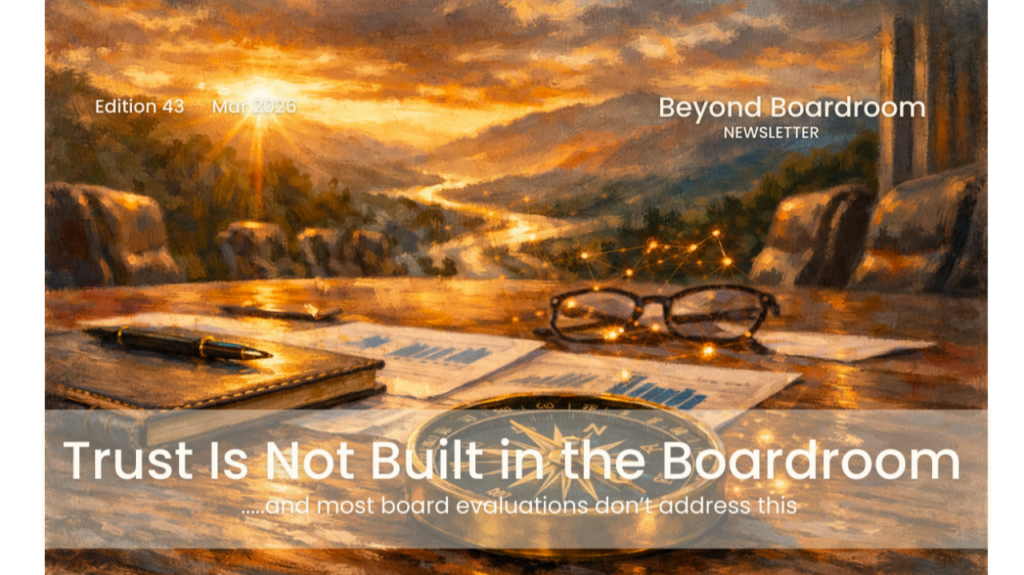
Here is the thing most boards do not want to hear: trust is not built during board meetings.
Board meetings are where trust is tested. Where it is spent. Where the absence of it becomes visible. But the building happens somewhere else entirely.
It happens in the conversation over breakfast before a long board day. In the debrief in the taxi on the way to the airport. In the text message to check in on a director who seemed quieter than usual. In the phone call that has nothing to do with agenda items.
When I was interviewing highly effective governance professionals for The Secret Diary of a Company Secretary, this was one of the most consistent themes across every chapter. The people who described high-trust board environments did not talk about the structures. They talked about knowing people as individuals.
High-trust boards are also, typically, the noisiest ones. They argue. They send papers back. They challenge. They go back on decisions they thought they had made. The absence of conflict is not a sign of trust, it is a sign of complacency dressed up as consensus. And in my experience, governance professionals know the difference between a genuinely aligned board and one where people have simply stopped saying what they think.
The question is whether anyone is doing anything about it.
How trust is quietly destroyed; the three mechanisms nobody names
Boardroom trust is rarely destroyed in a single dramatic moment. It erodes. Gradually. Through repeated small acts that are invisible unless you know what to look for.
The first is information filtering. The board only knows what management decides it should know. When that filtering becomes protective rather than editorial, when it is shaping what the board sees in order to manage a reaction rather than inform a decision, trust fractures. Many scandals have a root cuase in systematically filtered information. The board did not know what it did not know. That ignorance was not accidental. It was constructed.
The second is the pre-meeting meeting. When key decisions are effectively settled before anyone takes their formal seat at the board table, the board meeting becomes a performance. Directors who sense this, and experienced directors always do, disengage. Some become cynical. Some become compliant. Neither is what governance requires.
The third is what I call the accommodating minute; the written record that reflects what the board wished it had said, rather than what was actually said. One of the governance professionals I interviewed for my book put it with devastating honesty:
“The minutes are what the board wished they had said, written by a secretary who spent hours making it sound that way.” — Chapter 2
Minutes are a legal document. They are also a trust document. A governance professional who is asked to produce a record that flatters rather than reflects is being asked to undermine the very function they exist to protect. That is worth naming clearly, because it happens more than the profession acknowledges.
The early warning signs — what to watch for before it becomes a crisis
One of the sharpest questions this week in New Zealand was about early indicators of trust erosion. It is one of the most important areas of governance practice and one of the least discussed.
The signs are behavioural before they are structural. They show up in the room long before they show up in a board evaluation.
Directors begin asking for significantly more information than usual.
Or they suddenly stop asking questions altogether. The second is more alarming.
Side conversations migrate out of the boardroom.
When the real discussions are happening in corridors and car parks rather than in the meeting, the formal governance process has been bypassed. The meeting is a formality. The board has already fractured.
Management presentations become more polished and less honest.
High production values in a board paper are occasionally a sign of clarity. More often, they are a sign that someone is managing the narrative rather than sharing the reality.
The Chair starts managing the agenda rather than the discussion.
This one is subtle. The agenda exists to structure the discussion. When it starts functioning as a mechanism to avoid certain conversations, the Chair has stopped leading and started controlling. Those are not the same thing.
The governance professional is usually the person in the room best positioned to see these patterns early. The question is what to do with that knowledge.
Three things a governance professional can do to support the board with trust
Governance professionals do not want to stop at the diagnosis. Neither do I. So here is what practical intervention actually looks like.
1. Run an informal trust audit
Not a formal process. A deliberate, quiet observation exercise. Over the next two board cycles, watch specifically for the warning signs above. Who speaks, and who doesn’t? What information reaches the board, and what doesn’t? Where do the real conversations happen? You are not gathering evidence in order to start a fire. You are building an evidence base for a well-timed, well-placed conversation with the Chair, or with an individual director, or with yourself about what you are willing to name.
2. Challenge the agenda
An agenda is a governance document. It shapes what gets discussed, and therefore what gets decided. A board that consistently rushes complex items because the agenda is overloaded is a board that is structurally prevented from having honest conversations. Governance professionals have more legitimate authority over agenda design than most of them exercise. Use it. If there is a topic that keeps getting deferred, ask why. If the agenda consistently looks like it was designed to get through rather than to govern, say so.
3. Introduce the after-action debrief
One of the most underused tools available is the honest ten-minute conversation after a significant board decision. Not a formal evaluation, a simple, direct: what worked, what didn’t, what would we do differently. High-trust boards do this naturally. Lower-trust boards need the structure to make it feel safe. As the governance professional, you can create that structure. You do not need formal authority to ask, quietly, whether the board found that discussion useful.
None of this is dramatic. That is the point. Trust is built in small, consistent, deliberate acts and so is the governance professional’s credibility as the person who tends to it.
The role you are actually here to do
There is a version of the company secretary profession that is essentially administrative. Papers, minutes, statutory compliance. That version of the role is under real pressure. AI will absorb significant parts of it. The question is what replaces it and that question is for governance professionals to shape.
The governance professionals who will be indispensable in the next era of this profession are not the ones who know the most compliance frameworks. They are the ones who understand that their most important work happens in the informal space between meetings. Who see themselves as relationship architects and signal readers. Who have the courage to name what is happening in the room when nobody else will.
One of the governance professionals I interviewed for my book described it in terms I have not been able to improve on:
“We should be in the thick of it — shaping decisions, building relationships, holding people accountable and on occasion calling out the absurdities of certain decisions like an internal whistleblower. After all, our role is to be the conscience of the company.” — Chapter 2
The conscience of the company. That is not administrative language. That is strategic language. And it describes something that no AI will ever do, because it requires judgement, it requires courage, and it requires trust; the trust that takes years to build and seconds to destroy.
The work of governance is not administrative. It is structural and it is moral. And the boards that understand that, with the governance professionals in them who hold that truth firmly, are the ones that do not end up in the pages of a public inquiry.
Until next time — build it deliberately, protect it fiercely, and never assume it will look after itself.
Erika