There’s a particular quality to conversations with people who have stood at the edge of a critical call, felt the weight of the decision, and lived with the outcome. It’s not bravado. It’s not polished corporate narrative. It’s something rawer, a kind of hard-won clarity that only comes from having been tested.
I’ve spent nearly twenty years inside boardrooms, watching how decisions get made when the stakes are real. Not the sanitised version that appears in annual reports or investor presentations, but the actual human process: the fear, the politics, the moments of moral clarity and moral compromise, the weight of knowing that what you decide today will ripple through thousands of lives.
What strikes me most is how rarely we talk honestly about this. We have endless literature on leadership theory, governance frameworks, strategic models. What we have far less of is candid conversation about what it actually feels like to make the hard calls and what separates the leaders who get it right from those who don’t.
The gap between theory and reality
Corporate governance, as it’s typically taught and discussed, can feel strangely bloodless. We talk about fiduciary duties, risk appetites, stakeholder matrices. We produce frameworks and codes and best practice guides. All necessary, all important but none of it quite captures the visceral reality of sitting in a room where a decision must be made and there is no good option, only less bad ones.
Consider the pension dilemma. A company faces a £300 million shortfall. The numbers are clear enough. But behind those numbers are real people employees who planned their retirements around promises that were made to them, shareholders who have their own legitimate expectations, a workforce watching to see whether the leadership can be trusted. The spreadsheet doesn’t tell you how to weigh those competing claims. The governance code doesn’t tell you what fairness looks like when fairness to one group means unfairness to another.
Or consider the whistleblower’s dilemma; not from the board’s perspective, but from the individual who sees something wrong and must decide whether to speak. The personal and professional repercussions can be devastating. Careers end. Relationships fracture. The system that should protect truth-tellers often punishes them instead. And yet without these people, some of the most egregious corporate failures would never have come to light.
These are the moments that reveal what leadership actually is. Not the vision statements or the strategic plans, but the choices made when choosing is hard.
What corporate scandals actually teach us
When we study corporate failures, Wirecard, Enron, the cascade of banking crises and other more recent scandals, there’s a temptation to look for the villain. The fraudulent CEO, the captured board, the regulator asleep at the wheel. And sometimes there are villains. But more often, the picture is more troubling: decent people, operating within systems that made it progressively easier to look away.
The warning signs were there. They usually are. But information got filtered as it moved up the hierarchy. Difficult truths got softened into palatable summaries. The tone from the top created a culture where challenge felt risky and compliance felt safe. Non-executive directors, who should have been the genuine check on leadership, either didn’t ask the hard questions or didn’t push when the answers were inadequate.
This is uncomfortable because it implicates structures, not just individuals. It suggests that the problem isn’t simply finding better people—it’s building systems where good people can actually do good work. Where truth can travel upward. Where dissent is heard rather than punished. Where the governance function isn’t just a compliance exercise but a genuine source of accountability.
I’ve come to believe that the most important question you can ask about any organisation isn’t what its governance structure looks like on paper. It’s this: when someone at the bottom sees something wrong, what actually happens when they try to raise it?
Fear, politics, and the sanitisation of truth
One of the patterns I’ve observed across almost every governance failure is the role of fear in shaping what information reaches decision-makers. Not dramatic, obvious fear, but the subtle, pervasive kind that shapes behaviour without anyone quite naming it.
The middle manager who knows the project is off track but softens the message because the CEO doesn’t like bad news. The finance director who raises a concern once, gets pushback, and decides not to raise it again. The board paper that presents three options but makes clear which one the executive wants. The non-executive who senses something is wrong but doesn’t have the evidence to prove it and worries about being seen as difficult.
None of these are dramatic acts of cowardice. They’re ordinary human responses to ordinary organisational pressures. But cumulatively, they create a system where truth gets progressively filtered, where the picture that reaches the top is cleaner and more reassuring than reality warrants.
The antidote isn’t simply telling people to be braver, though courage certainly matters. It’s building cultures where honesty is genuinely valued, where bringing problems forward is rewarded rather than punished, where leaders actively seek out the information that challenges their assumptions rather than waiting for it to arrive (which it often won’t).
What effective leadership actually looks like
The leaders I’ve most admired share certain qualities that don’t always appear in leadership textbooks.
They engage with ground-level truth. Not through town halls and employee surveys, though those have their place, but through genuine, sustained contact with people across the organisation. They know what’s actually happening on the front line because they’ve made it their business to find out, and they’ve created relationships where people feel safe telling them.
They hold complexity without rushing to resolution. The hardest decisions rarely have clean answers. Effective leaders can sit with ambiguity, weigh competing considerations honestly, and make calls without pretending the trade-offs don’t exist.
They take responsibility for culture, not just strategy. They understand that the tone they set, what they reward, what they tolerate, what they ignore, shapes behaviour far more than any policy document. They know that culture isn’t what you say; it’s what you do when no one’s writing it down.
And perhaps most importantly, they have moral clarity about what they will and won’t accept. Not rigid rule-following, but a genuine ethical compass that guides decisions when the path isn’t clear. They’ve thought about their principles before they’re under pressure, so they have something to fall back on when the pressure arrives.
Why this matters now
We’re in a moment when trust in institutions, corporate, political, regulatory, is fragile. Scandal after scandal has eroded confidence that organisations are being run in the interests of the people they’re supposed to serve. The response has been more regulation, more compliance requirements, more governance codes.
These have their place. But they’re not sufficient. You can tick every box and still preside over a culture that’s fundamentally broken. You can have impeccable governance documentation and still fail to ask the questions that would reveal the truth.
What’s needed is something harder to mandate but more fundamental: leaders who genuinely care about getting it right. Boards that function as real checks on power rather than rubber stamps. Cultures where accountability isn’t a compliance exercise but a lived value. Governance professionals who understand their role as guardians of integrity, not just processors of paperwork.
This is why I’ve become increasingly interested in the stories behind the decisions—the human reality of what it means to lead when the stakes are real. The turnaround that nearly failed. The scandal that was averted because someone asked the awkward question. The whistleblower who paid a price but changed an industry. The chair who inherited a crisis and found a way through.
These stories matter because they show what’s actually possible. They reveal the gap between governance as it’s documented and governance as it’s lived. They offer something that frameworks and codes cannot: the texture of real experience, the lessons that only come from having been tested.
Beyond the sealed doors
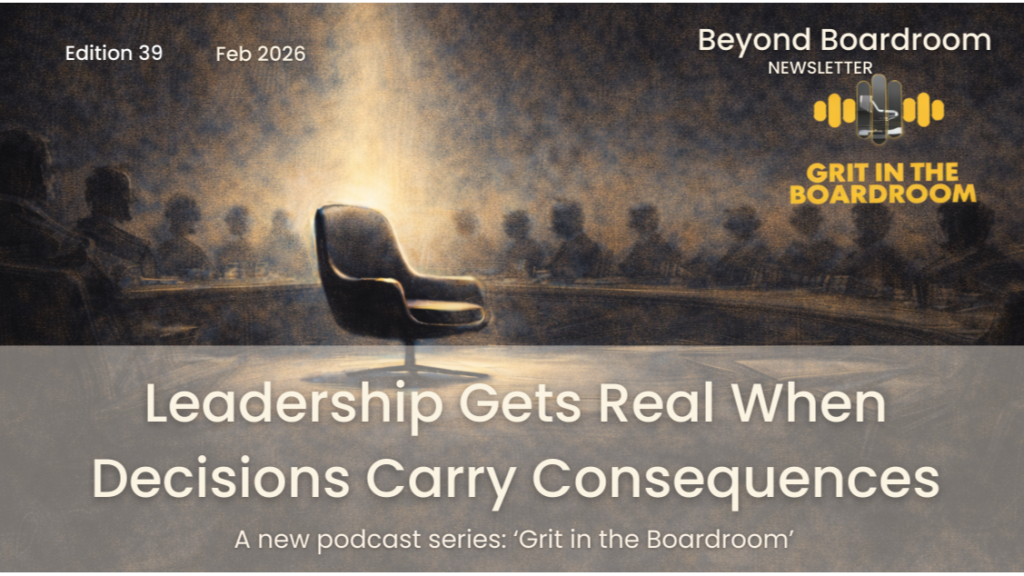
Next week I am launching my new podcast ‘Grit in the Boardroom’ because I wanted to create space for these conversations. Not the polished corporate narrative, but the real thing, executives, chairs, and directors talking candidly about the decisions that defined their careers, the moments of doubt and clarity, the lessons learned the hard way.
My first guests have set the tone. Roger Steare, known as the “corporate philosopher”, has advised organisations including BP, HSBC, Barclays, and Nationwide on ethical decision-making. His framework, Ethicability, offers a practical approach to moral reasoning that goes far beyond compliance. We talk about what happens when pension promises collide with commercial reality, how fear and politics sanitise the truth before it reaches the board, and why fairness and transparency aren’t soft concepts but strategic necessities.
Pav Gill, the whistleblower behind the exposure of Wirecard, one of Europe’s most infamous corporate collapses, shares what it actually means to see fraud from the inside and decide to act. We discuss the personal cost of speaking up, what governing boards should learn from scandals like Wirecard and 1MDB, and the role that empathy and courage play in decisions that most governance frameworks don’t even acknowledge.
These aren’t easy conversations. They don’t offer simple answers or neat frameworks. What they offer is something more valuable: the truth about what leadership looks like when the decisions carry real consequences.
Because that’s when leadership gets real. Not in the strategy away-days or the annual reports. In the moments when you have to choose, when the outcome is uncertain, when people are watching to see what you’re made of.
Those moments reveal everything. And we don’t talk about them nearly enough.
Until next time,