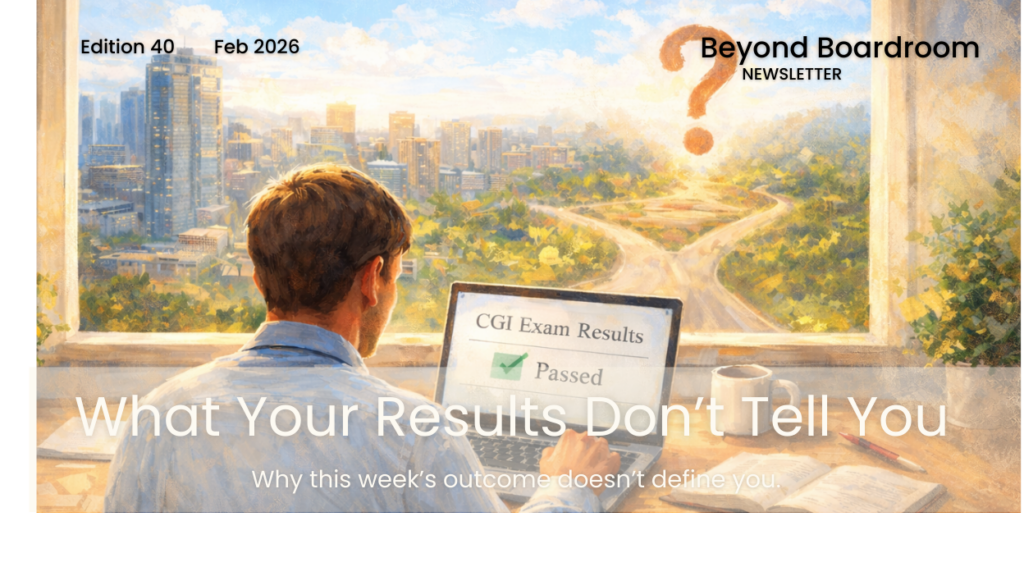
This week, thousands of governance students discover whether they have passed their CGI qualifying exams. But passing an exam and being ready to govern are not the same thing.
There is a particular kind of silence that settles over someone opening examination results. That moment of truth carries weight disproportionate to the paper or pixels delivering it.
This week, that silence will visit thousands of aspiring governance professionals across the country. The Chartered Governance Institute’s (CGI) qualifying programme results are landing, and with them come the familiar rituals: the relief of passing, the disappointment of falling short, the frantic refreshing of inboxes by those convinced the email has gone astray.
I remember my own results. The peculiar mix of validation and anticlimax. The dawning realisation that a certificate, however hard-won, is permission to begin, not evidence of completion.
For those receiving good news this week: congratulations. You have demonstrated commitment, discipline, and the capacity to absorb and reproduce a body of professional knowledge. These are genuine achievements.
But I want to be honest with you. And honesty, in governance, should be our stock in trade.
The Uncomfortable Truth About Professional Examinations
Passing an examination proves you can pass an examination. It demonstrates familiarity with syllabus content, the ability to structure written answers under time pressure, and sufficient motivation to prepare adequately.
What it does not demonstrate, what no examination can demonstrate, is whether you will be effective when it matters. Whether you will speak up in a room full of senior people who do not want to hear what you have to say. Whether you will recognise the ethical line before you cross it, not after. Whether you will have the judgement to know when the technically correct answer is the practically wrong one.
This is not a criticism of the CGI programme specifically. It is a structural limitation of all professional qualifications. The gap between examination competence and professional effectiveness exists in law, in medicine, in accountancy, in every field where knowledge must be applied under pressure in contexts that textbooks cannot anticipate.
The question is whether we acknowledge this gap honestly and what we do about it.
What Students Actually Need
I have spent nearly two decades working with governance professionals at every stage of their careers. I have watched brilliant examination candidates flounder in their first board meeting. I have seen people who scraped through their qualifications become exceptional practitioners. The correlation between examination performance and professional impact is weaker than most of us care to admit.
What makes the difference? In my observation, three things matter far more than examination grades.
First, practical exposure. There is no substitute for being in the room when difficult conversations happen. Watching how experienced professionals navigate ambiguity. Seeing what happens when the textbook answer collides with organisational reality. This cannot be taught through case studies alone, it must be experienced, ideally with guidance from someone who has been there before.
Second, professional identity. The transition from student to practitioner requires more than knowledge acquisition. It requires developing a sense of who you are as a governance professional. What you stand for. Where your lines are. This identity forms through reflection, through mentorship, through making mistakes and learning from them. It cannot be crammed in the weeks before an examination.
Third, the confidence to challenge. Governance is not administration. It is the exercise of professional judgement in service of accountability. This requires the confidence to ask difficult questions, to push back on powerful people, to say “I’m not comfortable with this” when everyone else seems content. This confidence must be cultivated deliberately, it does not arrive automatically with a certificate.
The best professional education develops all three. The question is whether our current approach does so adequately.
Why We Acquired Campbell’s College
I am not a neutral observer in this conversation. Beyond Governance’s acquisition of Campbell’s College, effective from July 2026, reflects a considered view about what governance education should become.
Alan Campbell taught me when I was a young professional facing an ethical crisis that could have ended my career before it properly began. What I learned from him was not syllabus content, though he knew that comprehensively. What I learned was how to think about governance. How to recognise when something was wrong even when I could not immediately articulate why. How to find courage when speaking up felt dangerous.
That experience shaped everything that followed. It is why I reached board level at thirty-two. It is why I survived and eventually thrived in environments that destroyed other capable people. The technical knowledge mattered, but the formation mattered more.
Campbell’s College has been providing that kind of formation for years, preparing students for CGI examinations while also developing the practical wisdom that examinations cannot test. When the opportunity arose to bring that capability into Beyond Governance, the decision was straightforward.
This is not merely a business acquisition. It is a statement about what we believe governance education must become.
The Future of Governance Education
Let me be direct about what I think is wrong with how we train governance professionals.
We front-load knowledge and back-load application. Students spend months absorbing content, sit examinations, receive qualifications, and only then discover what the work actually involves. This sequence is backwards. Integration of theory and practice should happen from day one.
We assess the wrong things. Examination success correlates with certain cognitive abilities and study habits. It does not correlate reliably with the qualities that distinguish exceptional governance professionals: judgement, courage, political intelligence, the ability to build trust with boards and executives. We measure what is easy to measure, not what matters most.
We underinvest in ongoing development. The assumption that qualification marks the end of structured learning is absurd in a field where regulation, technology, and stakeholder expectations evolve constantly. Yet most governance professionals receive less systematic development after qualification than before it.
We isolate students from practitioners. The people best placed to prepare students for professional reality are those currently navigating it. Yet traditional education models keep these groups largely separate. Students learn from academics and textbooks; practitioners learn from experience. The synthesis happens by accident, if it happens at all.
These are the problems Campbell’s College under Beyond Governance will address. Not by abandoning examination preparation, students still need to qualify, but by embedding that preparation within a broader developmental model.
A Word to Those Who Did Not Pass
If you opened your results this week and found disappointment, I want to speak to you directly.
Examination failure is painful. It is natural to feel discouraged, embarrassed, perhaps questioning whether this profession is for you.
But consider this: some of the finest governance professionals I know failed examinations on their first attempt. The qualities that make someone effective in practice, willingness to challenge, discomfort with superficial answers, tendency to see complexity where others see simplicity, can actually work against examination success. The examination rewards clarity and structure; professional reality often demands tolerance for ambiguity.
This is not an excuse. If you failed, you need to understand why and address it. Perhaps your preparation was inadequate. Perhaps your examination technique needs work. Perhaps you faced circumstances that compromised your performance. Whatever the reason, it can be overcome.
What matters now is what you do next. Every setback is information. Use it.
The Question That Matters
Whether you passed or failed this week, whether you are a student or seasoned practitioner, whether you work with Beyond Governance or have never heard of us until today one question should stay with you.
What kind of governance professional do you want to become?
Not what qualifications you want to hold. Not what title you want on your business card. But what kind of professional presence do you want to have? What do you want to be known for? When people describe you to others, what do you want them to say?
Examinations are milestones on a longer journey. They mark progress, but they do not determine destination. The destination is shaped by choices made daily: whether to speak up or stay silent, whether to prioritise compliance or genuine accountability, whether to accept “good enough” or insist on excellence.
The results are in. The real question is what comes next.
For those building careers in governance, the answer to that question will matter far more than any examination grade.
Until next time, keep choosing the harder right over the easier wrong, keep raising the standard and most of all, happy Friday!
Erika